
Revenue model
The Next Organization helps you rethink your revenue model.
Read more about Revenue model
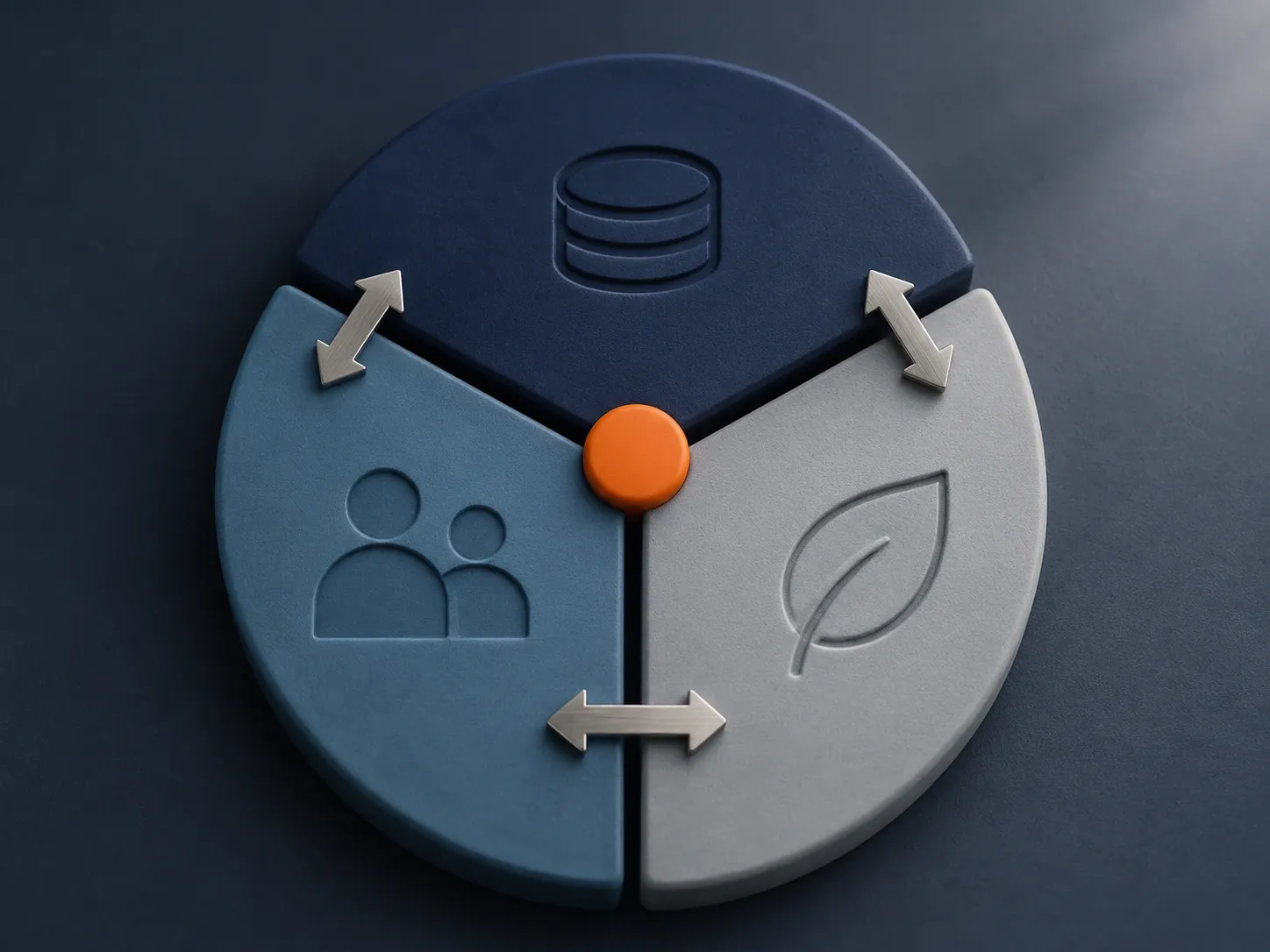
Business model and financeSustainable business model
Sustainability only pays off when it is part of your business model, not an add-on. A sustainable business model creates value on three layers: economic, social and environmental. The Next Organization helps you connect those layers, so that sustainability makes economic sense too.
Your business model describes how your organisation creates, delivers and captures value. A sustainable business model starts at the core: why you exist, how you work and what value you create for customers, for society and for yourself. Our framework is based on our own research with universities on the transition to sustainability.
This is what each layer covers:
What it covers
Staying profitable and managing resources well, so your organisation can keep operating
Examples
What it covers
The wellbeing of people, inside and outside your organisation
Examples
What it covers
Keeping nature intact with products and processes that protect the environment
Examples
The gains lie in the links between the layers. Using less energy also lowers your costs. Engaged employees stay longer. That is how your contribution to society shows up in your business case.
The European reporting obligation now only applies to large companies. Even so, customers, supply chain partners and public buyers still ask for data. With a sustainable business model, you answer those questions on the basis of your own strategy.
You get a business model in which sustainability contributes to your results, with a roadmap that takes you from separate initiatives to a structural approach. You answer questions from customers and supply chain partners with consistent figures. And because sustainability sits at the core, it is not dropped at the first setback.
Sustainable business practices are often about individual measures, such as solar panels or less waste. In a sustainable business model, sustainability is built into your proposition, your revenue model and your choices. That way it adds to your results instead of only costing money.
Translate every social and environmental effort into economic value. Think of lower energy costs, lower staff turnover or better financing terms. Start with visible, practical steps and build on them one at a time.
Start with your vision, mission and ambition: what contribution do you want to make, and why? Translate that into choices in your proposition, your offering and your processes. That way sustainability becomes a permanent part of your direction rather than an afterthought.
Expertise
Strategy affects everything. These themes are closely connected.
The Next Organization helps you rethink your revenue model.
Read more about Revenue model
Many partnerships start with enthusiasm and stall later on.
Read more about Network Business Model CanvasBook a no-obligation sparring session. We will think through your challenge with you and show how we would tackle it together.