
Customer insights
Customers often change faster than organisations notice.
Read more about Customer insights
PropositionCustomer journey
Customers judge you on the entire journey, not on a single department. The Next Organization maps the customer journey for each target group, from the first need to the exit. That shows you where you add value and where things go wrong.
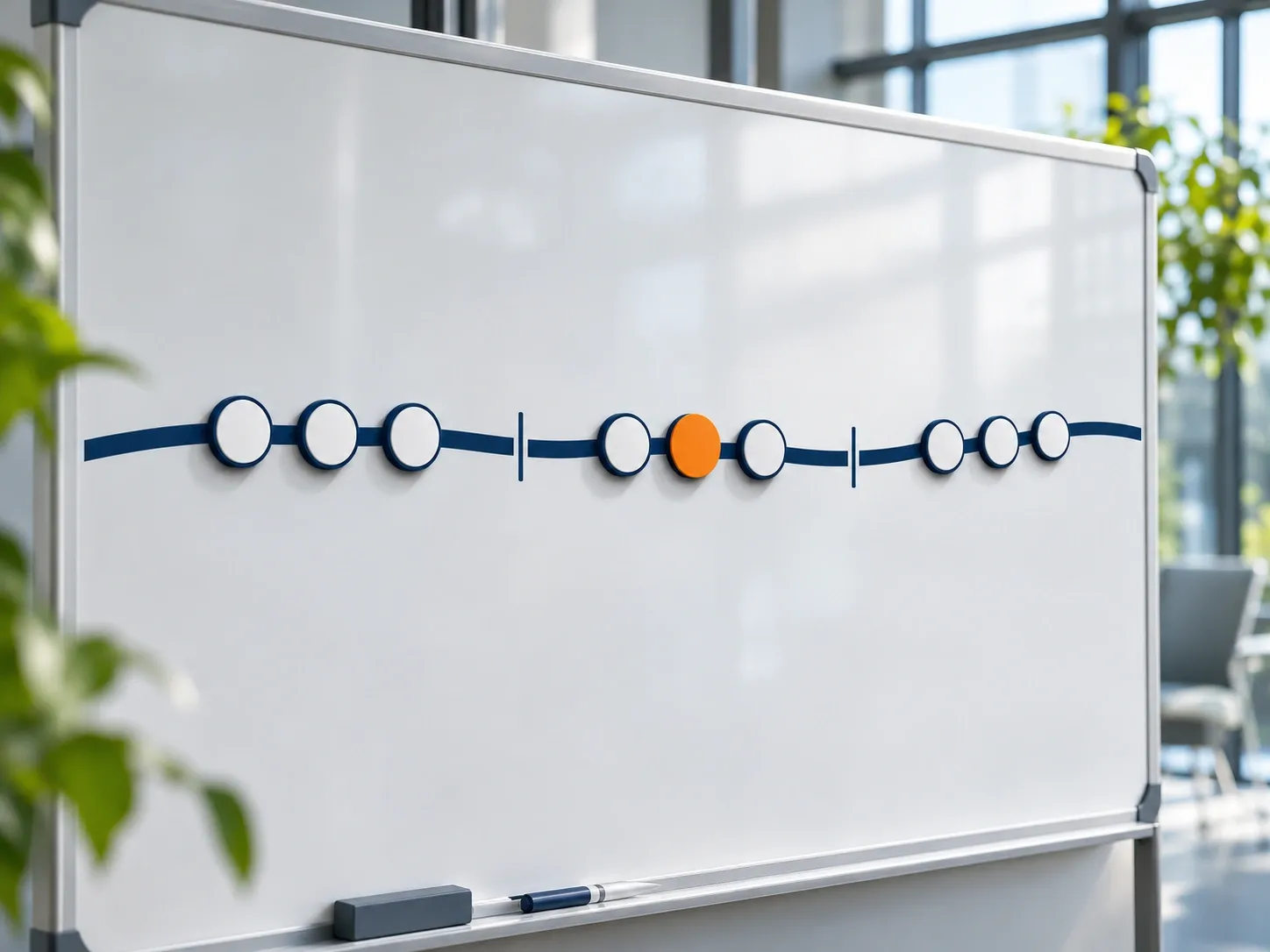
A customer journey describes, step by step, what a customer does and experiences with your organisation. A customer journey map lays out those steps at a glance. We work with three fixed phases, so that the journeys of different target groups stay comparable.
The line shows how the customer experiences the journey; the diamonds are moments of truth.
What happens
The customer discovers a need, explores the options and chooses
The question
How does the customer find us, and why do they choose us?
Moment of truth
What happens
The customer uses the offering and is in touch with you
The question
Does it work as promised, and where does friction arise?
Moment of truth
What happens
The customer renews, buys more or leaves
The question
Why does the customer stay, and what happens when they leave?
Moment of truth
Example: the customer journey of a venue for events. The line is illustrative only.
Every phase contains moments of truth: moments when the customer forms a judgement. They are often small, and that is exactly where you win or lose trust.
The customer journey builds on your Target groups and tests whether your Value proposition holds up in every phase.
For each target group you get a customer journey with the steps in every phase. For each step you can see what the customer does, what they need and through which channel. You know where the journey goes wrong and which improvements come first.
Choose one target group and set out the three phases. For each phase, fill in the steps from the customer's point of view: what do they do, what do they need, which channel? Mark the moments of truth and test the result with real customers.
You use the customer journey to choose improvements and to focus departments on the same customer. The journey shows whether your Service model and communication deliver on the promise. In a change programme, it is a starting point for Processes and systems.
A funnel follows the customer up to the purchase and mainly measures conversion. A customer journey continues after the purchase, up to and including renewal or leaving. That way you see why customers stay or leave, not just why they buy.
Look at where customers get in touch when they would rather not have to. That is often around exceptions, such as a rejection or a delay. Solve those, and much of the contact disappears by itself.
Expertise
Strategy affects everything. These themes are closely connected.
Customers often change faster than organisations notice.
Read more about Customer insights



Book a no-obligation sparring session. We will think through your challenge with you and show how we would tackle it together.